How AI Investigated 9,601 Hillary Clinton Emails
See how Classifyre autonomously investigated 9,601 Hillary Clinton email files, tested 20 detectors, and opened eight evidence-backed cases.
Early on Day One, Classifyre opened its first inquiry into the Clinton email corpus. It was not about classification markings, diplomatic cables, or legal privilege. It was about email addresses.
The system had found a simple pattern in the first part of the scan: official
state.gov addresses and personal clintonemail.com addresses recurring in
the same body of correspondence. Eight minutes later, it opened a case to ask
what that overlap meant. It attached evidence, proposed two testable
hypotheses, and added the first names and aliases to a working glossary.
That was the beginning of our first investigation of real public data with Classifyre. Over the next three days, the same AI harness wrote and tested detectors, retired ideas that produced nothing, separated release stamps from substantive markings, opened seven standing inquiries, and assembled eight cases for review.
You can inspect the resulting Clinton email investigation in the Classifyre showcase. The namespace exposes the detectors, inquiries, cases, hypotheses, discussion threads, and timelines described below.
The short answer: Classifyre autonomously scanned 9,601 public Hillary Clinton email files, tested 20 detector ideas, kept 14, retired six, built seven monitoring inquiries, and opened eight evidence-backed cases. The AI did the investigative organisation itself; people still verify terminology and decide what the evidence ultimately means.
This is the record of how it happened. It is not a verdict on the people in the corpus, and a detector match is not proof of wrongdoing. The open cases are questions with evidence attached, not conclusions with question marks added afterward.

One source, deliberately
We connected one source: from-our-page/hillary-clinton-emails-wikileaks, a public text dataset on Hugging Face. We did not add newspaper coverage, Congressional reports, biographies, or a second copy of the archive. At the snapshot used for this article, Classifyre had ingested 9,601 text assets from that source. They had produced 312,733 open finding rows, a volume dominated by broad entity detection and recurring release metadata rather than 312,733 separate conclusions.
The narrow scope was useful. It forced the system to distinguish what the documents actually contain from what is commonly said about them. It also created an important limit: this investigation can establish that a string, marking, address, or release code appears in this corpus. It cannot, from this source alone, settle why it appears, whether the underlying document is authentic in every respect, or what legal conclusion follows.
You can follow the ingestion history yourself in the
full scan log for
the namespace. The first scan used the built-in PII detector. That gave the harness names,
places, dates, addresses, URLs, and other entities to work with. It also gave
it a great deal of rubbish. Ordinary words such as “Thankfully,” “OBITUARY,”
“IRELAND,” and “Breakthrough” were sometimes labelled as people or places.
Relative phrases such as “last weekend” appeared as dates. OCR damage turned
addresses into variants such as clintonennail.com and clintonemall.co.
This mattered because many of those mistakes ranked highly. A unique bad extraction can look statistically unusual, and unusual is not the same as important. The harness learned that lesson early and stored it in memory: in this corpus, generic PERSON, LOCATION, DATE_TIME, and NRP findings required scepticism; email addresses were the cleaner starting signal.

Evidence ranking made the noise visible
One
LOCATION finding
shows why. The PII detector had flagged the word OBITUARY at 85% confidence,
and Classifyre’s evidence ranking scored it importance 97 and evidence quality
88 — high on paper, boosted by readable context and a value that looked unique
in the corpus. The similar-findings graph attached to that finding tells the
real story: its closest neighbours are a LOCATION extraction of the same
OBITUARY string on a different asset, a URL finding pointing to
tnr.com/article/79956/richard-holbrooke-wieseltier-obituary, and stray
PERSON/NRP extractions such as Historian, Emeritus, and Deaths. A
separate Memorial Day value recurred often enough to collapse into an
explicit duplicate group across six assets. None of this is a person, a place,
or a date in any useful sense — it is one obituary section of the archive
being re-parsed by a general-purpose PII model.
This is what let the harness discount the cluster instead of chasing it: the same semantic-similarity view that surfaces genuine duplicate evidence across documents also surfaces duplicate noise, so a detector can be judged on whether its neighbours are corroborating signal or the same mistake repeated.

What the harness actually did
“The AI investigated it” is too vague to be useful. The work was divided among agents with different jobs and different mutation rights:
| Agent | Its job in this investigation |
|---|---|
| Inquiry | Find coherent, watchable groups of findings and create saved monitors. |
| Case | Turn monitored findings into cases, attach evidence, and maintain hypotheses and notes. |
| Config | Adjust source and correlation settings when noise or missing coverage became visible. |
| Detector author | Propose one missing class at a time, test it, create it, wire it to the source, and check the real scan result. |
| Escalation | Notify an operator only after checking that a case had substantive, non-boilerplate evidence. |
| Dream | Consolidate memory and rewrite the short system brief after the investigation had accumulated enough history. |
A separate duplicate pass maintained fingerprints and clusters as the corpus
grew. This was not cosmetic. At one point, the ubiquitous UNCLASSIFIED
release stamp and generic date values were making unrelated documents look
nearly identical. The configuration agent reduced their correlation weight to
zero, allowing shared addresses, names, and specific detector values to carry
more of the comparison.
By Day Four, the audit trail contained 743 agent runs, each one inspectable as a flight in the AI harness activity log:
| Run type | Runs |
|---|---|
| Duplicate and fingerprint maintenance | 476 |
| Inquiry review | 65 |
| Source and correlation configuration | 61 |
| Case work | 51 |
| Escalation review | 45 |
| Detector authoring | 44 |
| Memory consolidation | 1 |
Those runs produced 1,270 recorded business actions and 115 long-lived memory entries. The memory store was not a transcript dump. It held source profiles, detector lessons, entity maps, and decision precedents such as “do not open a blanket inquiry over noisy PERSON findings” and “do not alert this case again unless its severity rises.”
The investigation work itself is attributable in the API: the seven inquiries
and eight cases were created by ai-autopilot, detector creation and source
changes appear as agent decisions, and case evidence has the same audit trail.
Humans were not removed from responsibility. The glossary entries were
operator-verified, and the cases remain open for human review.
What “autonomous” meant here
No operator handed the harness a prepared list of eight cases. The agents repeated a stateful loop: inspect what the namespace knows, choose one uncovered question, take a permitted action, test the result, record the decision, and return later when the scan has changed. The work survived between runs in the namespace rather than disappearing at the end of a chat response.
That distinction is visible in the sequence of events:
| When | What the AI did |
|---|---|
| Day One, morning | Created the first inquiry after identifying email addresses as the cleanest useful signal in noisy PII output. |
| Day One, morning | Opened the personal-versus-official email case, selected evidence, and drafted two hypotheses. |
| Day One, late morning | Began the first custom-detector probe, recovered from two invalid tool inputs, passed positive and counter-example tests, and sent the detector to the source. |
| Day One, afternoon into evening | Added handling, network, cable, and legal-privilege inquiries as their detector results became reviewable. |
| Day Two, just after midnight | Opened the high-severity Top Secret case, then noticed that the related inquiry did not actually include regex:top_secret. |
| Day Two, early hours | Widened the existing handling inquiry instead of creating a duplicate monitor. |
| Day Two, early hours | Revisited the Top Secret case after a re-sweep, explained two new findings, attached them, and recorded that 427 other high-ranked items were PII noise. |
| Day Two into Three | Opened the FOIA and Foundation cases, linked new evidence, and identified FOIA release controls as a coherent group that still lacked an inquiry. |
| Day Four | Rechecked open themes at full-corpus coverage and retained unresolved hypotheses rather than forcing closure. |
This is what the automation brought in practice: persistence. A detector author could create a new signal; the inquiry agent could notice it; the case agent could attach selected evidence and state a hypothesis; and a later run could challenge, expand, or reject the earlier work. Every step left a timeline entry that an investigator can inspect.
The whole run was cheap. Every agent: detector author, inquiry agent, case agent, ran on DeepSeek V4 Flash, and the four-day investigation across 9,601 assets, 20 detectors, seven inquiries, and eight cases cost $4.91 in total model spend. The full run-by-run breakdown is visible in the harness usage graph.

The first useful question was not the dramatic one
The inquiry agent’s first saved monitor watched email addresses. Its rationale was plain: these were readable, high-confidence values with cross-document recurrence, and no inquiry covered them.
The case agent then opened Personal email accounts in official State
Department correspondence. Today it is the only case marked IN_PROGRESS;
the other seven remain OPEN. It contains 17 evidence assets and 19 attached
email-address findings. The attached set includes state.gov correspondents,
personal clintonemail.com addresses, an att.blackberry.net address, and OCR
variants that the case treats as damaged forms rather than new identities.
Two hypotheses are currently marked supported:
- personal
clintonemail.comaccounts carried official State Department correspondence — confidence 0.75; - State Department officials were correspondents in that traffic — confidence 0.70.
Those confidence values describe the state of the case, not a legal judgment. The strongest evidence is co-occurrence in the corpus: official and personal addresses appearing in the same messages, plus recurrence across documents.
This first case also set a pattern for the rest of the investigation. The harness did not open a case for every high-ranked item. It reviewed the noisy unmonitored groups, documented why they were weak, and kept returning to the address pattern because it survived that review.
How a detector probe became a real detector
Later that same morning, the detector-author agent took its first turn. It saw a State
Department email corpus with built-in PII findings but no custom detectors. It
hypothesised that classification and handling markings were a missing class:
SECRET, CONFIDENTIAL, SBU, NOFORN, FOUO, EYES ONLY, and related
forms.
The probe was a four-stage process.
- Test a positive sample. The agent supplied representative text that should match the proposed regular expressions.
- Test a counter-example. It supplied ordinary prose containing nearby words, designed to catch over-broad patterns.
- Test the saved detector. After creation, it tested by detector ID to make sure the stored configuration behaved like the draft.
- Run it on the corpus. Only then did it add the detector to the source, request a rescan, and leave a pending-verification memory for the next cycle.
The first attempt was not smooth. The agent sent one invalid extra property, then wrapped the pipeline schema at the wrong level. Both calls failed. On the third attempt, the positive sample produced nine expected findings. The counter-example produced none. The saved detector then found seven expected items in the positive sample and zero in the counter-example.
That distinction — a passing synthetic probe followed by a real-corpus check — became essential. Several ideas passed their positive and negative examples but produced zero findings in the actual email set. A correct pattern for text that is absent is still an unsuccessful investigative probe.
What worked, and what did not
The harness created 20 detector concepts over the three-day review. Fourteen are active now. Thirteen currently have findings; the newest compartmented- access detector has none. The live configuration for all of them is browsable in the custom detectors list.
These are the active detectors at the article snapshot. “Finding rows” is the API’s current count, not a count of people, offences, or unique documents. Release boilerplate and repeated values can make that number large.
| Active detector | What it looks for | Finding rows |
|---|---|---|
classified_handling_marks | SECRET, CONFIDENTIAL, SBU, NOFORN, FOUO, EYES ONLY, UNCLASSIFIED | 10,483 |
classified_network_references | SIPRNet, NIPRNet, JWICS, STU-III | 4 |
diplomatic_cable_references | STATE, SECSTATE, and embassy cable references | 4 |
state_dissemination_controls | LIMDIS, NODIS, SIPDIS, REL TO, E.O. references | 19 |
legal_privilege_markers | Attorney-client, work-product, and privileged/confidential markers | 28 |
clinton_foundation_references | Clinton Foundation and Clinton Global Initiative names | 24 |
foia_release_control_numbers | FOIA case, document number, and release-status stamps | 27,655 |
top_secret_handling_marks | TOP SECRET and TS compartment forms | 12 |
foia_case_number | State Department FOIA case numbers | 9,641 |
classification_authority_markings | Classification authority blocks | 8 |
foia_exemption_redaction_codes | Parenthetical exemptions and standalone B1–B7 lines | 3,731 |
state_dissemination_control_markings | EXDIS, ORCON, PROPIN, REL TO, and similar controls | 1 |
classification_reason_codes | E.O. 13526 reason codes such as 1.4(B) | 602 |
compartmented_access_handling_marks | SCI, SAR, TALENT KEYHOLE, BYEMAN, channel controls | 0 |
The zeroes were as informative as the hits. Six earlier concepts were retired from the active set after the real corpus did not support them:
| Retired probe | What happened |
|---|---|
intelligence_community_markers | The sample probe worked, but the scan found no SIGINT/HUMINT/COMINT-style marker set. |
cable_distribution_markings | No real cable distribution lines were found. |
foia_exemption_codes | The first inline/parenthetical version found nothing; the useful format turned out to be standalone State release-block codes. |
declassification_instructions | The pattern correctly matched test text such as DECLASSIFY ON, but the corpus produced no findings. |
sipdis_distribution_control_marking | The dedicated SIPDIS pattern passed its tests and then found no SIPDIS marking in the corpus. |
state_cable_tags | A TAGS: PREL, KDEM-style probe passed, but there was no real output and it was retired. |
The harness also refused some bad additions before they reached the active set. It rejected a custom email-address detector because the built-in EMAIL_ADDRESS pattern already covered that class. It rejected near-duplicate FOIA and classification-authority detectors and told the agent to sharpen the existing detector instead. At another point, it blocked new authoring until three zero-finding detectors were resolved. These refusals prevented the catalogue from becoming a list of slightly different names for the same idea.
The newest zero-result detector,
compartmented_access_handling_marks, remains active. It searches for the most
sensitive special-access terms. At this snapshot it has found nothing. The
honest result is not “the corpus is clear”; it is “this detector has no matches
and still needs a completed review or retirement decision.”
The glossary became part of the method
The agents proposed a glossary as they encountered names, aliases, damaged spellings, release codes, and institutional references. Operators verified all 17 current entries, which you can browse in the live glossary.
The glossary is small enough to inspect:
| Type | Entries |
|---|---|
| People (9) | Hillary Clinton; Huma Abedin; Cheryl Mills; Jacob “Jake” Sullivan; Sidney Blumenthal; Abdullah bin Zayed Al Nahyan; Hamad bin Khalifa Al-Thani; Hamad bin Isa al-Khalifa; Rachel Kleinfeld |
| References (7) | clintonemail.com; SIPRNet; FOIA cases F-2014-20439 and F-2016-07895; FOIA exemption codes; FOIA release control number; classification reason code |
| Organisation (1) | Clinton Foundation, including William J. Clinton Foundation, WJC Foundation, Clinton Global Initiative, and CGI aliases |
This was more than a list of definitions. It stopped the system from treating
HRC, HDR22, and “Hillary Rodham Clinton” as unrelated; connected
[email protected] with Jacob Sullivan; and recorded that
clintonennail.com and clintonemall.co are OCR or spelling variants found in
the data.
It also separated terms that look similar but answer different questions. A
FOIA exemption code such as B1 or B5 explains a release redaction. A
classification reason code such as 1.4(B) states the classification category.
A Doc No. C057xxxxx value identifies a released document. Treating all three
as one “classification code” would destroy the structure needed for the FOIA
case.
Seven inquiries: what the system keeps watching
An inquiry is a saved monitor, not a case. It answers: “Which new findings belong to this question?” The seven active inquiries currently contain the following match rows, and are browsable directly in the inquiries tab:
| Inquiry | Current matches | What it watches |
|---|---|---|
| State Department correspondents’ email addresses | 16,517 | Built-in EMAIL_ADDRESS findings in the source |
| Classified handling marks | 1,540 | Handling, Top Secret, and classification-reason detectors, excluding the ubiquitous UNCLASSIFIED stamp |
| Classified network references | 4 | The classified-network detector, currently SIPRNet matches |
| State Department diplomatic cable references | 4 | Cable-reference formats |
| Legal privilege markers | 28 | The legal-privilege detector |
| Clinton Foundation references | 24 | Foundation and CGI names |
| FOIA exemption redaction codes | 3,731 | The exemption-code detector |
The monitor sizes should not be compared as if they were vote totals. One email can contain several addresses. A release code can recur in repeated material. A four-match inquiry can be more important than one with thousands. The inquiry is useful because it preserves a narrow rule and supplies new material to the linked case.
The inquiry agent also changed its mind when necessary. The Top Secret case
initially exposed a monitoring gap: its regex:top_secret findings were not in
the handling inquiry’s finding-type filter. A later update widened the existing
inquiry rather than create another monitor for the same classification theme.
The current inquiry also includes classification reason codes.
This is a useful difference between search and an inquiry. A search gives an
answer for one moment. These inquiries preserve the source, detector keys,
finding types, and exclusions that define each question. When the source scan
advanced, the agent did not have to rediscover the question; it checked the new
matches against the same rule. All seven were created by ai-autopilot, and
each is linked to the case or cases that explain why the monitor exists.
Eight cases: the questions left open
Cases are narrower and more demanding than inquiries. They hold selected evidence, attached findings, hypotheses, notes, and links back to their monitors. The harness opened all eight current cases, which you can review in the live case list.
| Case | Status | Severity | Evidence assets / attached findings |
|---|---|---|---|
| Personal email accounts in official State Department correspondence | In progress | High | 17 / 19 |
| Classified handling marks | Open | Medium | 8 / 9 |
| Classified network references | Open | Medium | 4 / 4 |
| Legal privilege markers | Open | Medium | 5 / 6 |
| State Department diplomatic cable references | Open | Medium | 2 / 4 |
| Top Secret handling marks | Open | High | 5 / 5 |
| FOIA exemption redaction codes | Open | Medium | 7 / 7 |
| Clinton Foundation references | Open | Medium | 2 / 2 |
The case index: hypotheses, threads, and timelines
The case list is not just eight titles generated from detector names. At this snapshot, the case files contain 16 AI-created threads, 41 thread entries, and 158 timeline events. Hypothesis threads preserve the claim being tested and its current status. Discussion threads hold re-sweep notes, monitoring gaps, noise decisions, and follow-up work. Timelines show when evidence, inquiry links, notes, and supporting relationships changed.
| Case | Hypotheses at this snapshot | Threads / entries | Timeline events |
|---|---|---|---|
| Personal and official email accounts | Two supported: 0.75 and 0.70 confidence | 3 / 7 | 50 |
| Classified handling marks | Supported at 0.70; competing residual-stamp explanation proposed at 0.40 | 3 / 11 | 26 |
| Classified network references | SIPRNet presence supported at 0.60; incidental-reference explanation proposed at 0.40 | 3 / 5 | 16 |
| Legal privilege markers | Privilege-marker language supported at 0.60 | 1 / 1 | 9 |
| Diplomatic cable references | Multi-asset presence supported at 0.60 | 1 / 1 | 7 |
| Top Secret handling marks | Genuine-stamp interpretation proposed at 0.40 | 2 / 4 | 13 |
| FOIA exemption codes | Release-redaction interpretation supported at 0.80 | 2 / 11 | 32 |
| Clinton Foundation references | Presence in official correspondence supported at 0.70 | 1 / 1 | 5 |
The confidence figures are deliberately exposed because they make the cases reviewable. The AI was allowed to say “supported” when selected evidence met the working hypothesis, but it was also allowed to keep a competing explanation at 0.40. In the handling and SIPRNet cases, that is exactly what it did. This is more useful than a one-line AI summary because a reviewer can inspect the claim, the evidence linked in support, the counter-position, and the chronology that produced them.
Classification markings without a premature conclusion
The general handling-mark case contains attached examples of SECRET,
NOFORN, EYES ONLY, and Top Secret. Its supported hypothesis is limited:
the corpus contains genuine-looking classification and handling markings. A
second hypothesis remains proposed: the markings may be residual stamps on
forwarded or quoted material rather than classifications applied to the email
itself.
The separate Top Secret handling marks case is HIGH severity because its
attached findings are CRITICAL. One Top Secret finding had an importance
score of 0.97 and readable context. Several others belonged to a duplicate
group, which may mean the same stamp was repeated across assets. The case’s
main hypothesis remains PROPOSED at 0.40 confidence. That is the correct
posture: the string is present; its document context and significance still
need review.
Network and cable references
The network-reference detector found four SIPRNet mentions on four assets. The case supports the narrow statement that the references exist. It also carries the competing possibility that the mentions are incidental, quoted, or descriptive rather than evidence that correspondents used the classified network.
The diplomatic-cable case currently contains four attached references on two
assets: STATE 82581, STATE 86734, STATE 121442, and
11 STATE 121442. The question is where cable material appears and how it
entered or circulated in this email collection. Again, a cable number is a
lead, not proof that a particular message was itself a cable.
Privileged language
The legal-privilege case began with four verified findings on three assets: “privileged and confidential,” “attorney-client privilege,” and “attorney work product.” It has since grown to five evidence assets and six attached findings. None of the original verified items belonged to the boilerplate cluster the agent checked.
The supported 0.60-confidence hypothesis says the corpus contains genuine privilege-marker language. It does not decide whether privilege legally attached, whether it was waived, or whether the surrounding material should have been withheld. Those are different questions.
FOIA codes: a map hiding in the margins
The FOIA case may be the most useful result for a future investigator. It contains attached B1, B5, and B6 codes. In the U.S. Department of Justice’s FOIA reference guide, the corresponding exemptions cover:
- B1 is associated with national-security withholding;
- B5 with deliberative-process or privilege grounds;
- B6 with personal privacy.
The case asks whether B1-coded documents overlap the classification cases and whether B5-coded documents overlap the legal-privilege case. It does not yet answer that asset-level overlap question.
The harness also found a larger, still underused structure: document controls
such as Doc No. C057xxxxx, FOIA case numbers, and RELEASE IN FULL or
RELEASE IN PART. The dedicated release-control detector now has 27,655
finding rows, but none of the seven active inquiries watches that detector
directly. The memory store flags it as the largest coherent unwatched group.
Pairing document control numbers with B1/B5/B6 codes could turn a loose set of
redaction markers into a document-by-document release map.
That is both a surprising result and an honest gap. The system found the indexing material, but the current investigation has not yet converted it into a standing inquiry and completed overlap analysis.

Foundation references
The Foundation inquiry contains 24 current matches. The case has two selected
evidence assets and two attached findings: WJC FOUNDATION and
Clinton Global initiative. Its supported hypothesis is deliberately modest:
Foundation and CGI references appear across official correspondence in the
corpus. The case does not infer impropriety from those mentions.
What surprised us
The dramatic terms were not always the most useful findings.
The most common classification-related value, UNCLASSIFIED, was largely a
FOIA release stamp. Left untreated, it made unrelated documents look connected.
The useful action was to down-weight it, not celebrate thousands of matches.
The highest-volume finding category, PII, contained both the investigation’s first strong signal and its most persistent noise. EMAIL_ADDRESS linked personal and official correspondence. The same detector family also labelled ordinary words as people and locations. The harness had to remember both facts at once.
A detector can pass every probe and still fail the investigation. SIPDIS, declassification instructions, intelligence-community terms, and cable TAGS all behaved correctly on examples but found nothing in the live corpus.
And the least glamorous detector may create the best next research tool. FOIA document numbers and release stamps are administrative metadata, but they may provide the join key needed to compare redaction grounds, classification markers, and specific released documents.
What the autonomous AI actually added
The value was not that the model could search email text. A person with regular expressions can do that. The useful contribution was turning thousands of files and hundreds of thousands of raw findings into maintained investigative state:
- It made a review queue. Seven inquiries keep the important questions current, while eight cases separate evidence that needs judgment from the much larger pool of matches.
- It kept competing explanations alive. “The mark exists” and “the mark may belong to forwarded material” can coexist as separate hypotheses instead of being collapsed into a confident-sounding answer.
- It tested its own instrumentation. Positive probes, counter-examples, saved-detector tests, corpus scans, and later re-sweeps exposed the difference between a good regex and a useful detector.
- It remembered rejected work. Duplicate detectors, empty probes, PII errors, and boilerplate exclusions were recorded, so the next cycle did not repeatedly make the same proposal.
- It found operational gaps. The agent noticed that Top Secret findings were missing from an apparently relevant inquiry and repaired the filter. It later identified FOIA document controls as a large coherent group that no inquiry was watching.
- It produced an audit trail. Case timelines show evidence additions, hypothesis links, inquiry changes, and agent notes. A reviewer can reconstruct the path to a claim instead of trusting a polished final paragraph.
That is the marketing claim this example can honestly support: Classifyre did not merely label a public dataset. Its AI agents independently organised the work into detectors, monitors, cases, hypotheses, evidence links, discussion threads, timelines, and remembered decisions. What they brought was continuity and structure. What they did not bring was the authority to turn an open hypothesis into a fact.
What this investigation does not establish
The article would be misleading without this list.
- A match for
SECRET,Top Secret, orSIPRNetdoes not by itself establish the status of the email containing it. It may be a release stamp, quoted material, a forwarded document, or an incidental reference. - Finding counts are not unique-document counts. A document can contain multiple matches, and recurring release text can dominate a detector.
- Importance and confidence scores rank evidence inside this system. They are not probabilities that an allegation is true.
- The source is a single public dataset. There is no independent source in this namespace to corroborate context or provenance.
- None of the eight cases is closed. The current posture is active post-scan review, not completed adjudication.
- The glossary was proposed by agents but verified by an operator. Final case conclusions also remain a human responsibility.
What should happen next
The investigation now has a concrete queue rather than a vague promise to “analyse the emails.”
First, create or extend an inquiry for FOIA release control numbers, then join document numbers to the exemption-code case. Second, perform the asset-level overlap checks already named in the FOIA hypotheses: B1 against classified marking cases, B5 against the privilege case. Third, review the repeated Top Secret group in source context to separate one copied stamp from independent documents. Fourth, resolve the zero-result compartmented-access detector. Finally, add an independent source only when there is a specific corroboration question; adding more data for its own sake would make the evidence trail harder to read.
The useful result of this first real-data run is not that an AI “solved” a famous archive. It did not. The result is a reviewable investigation: failed probes are visible, noise has recorded reasons, aliases have provenance, monitors have explicit rules, and cases say what remains uncertain.
That is a much better place to begin serious work than a search box and 9,601 files.
Questions about this AI investigation
Did AI create the Clinton email inquiries and cases on its own?
Yes. The namespace API attributes all seven inquiries, all eight cases, and all
16 case threads to ai-autopilot. The agents chose uncovered themes, created
or refined detectors, attached evidence, drafted hypotheses, and revisited the
work after later scans. Operators verified glossary entries and retain
responsibility for final conclusions.
What did Classifyre find in the Hillary Clinton email dataset?
It found classification and handling marks, four SIPRNet references, four diplomatic cable references, legal-privilege language, Foundation references, FOIA exemption codes, email-address relationships, and extensive FOIA release metadata. These are detector results and investigative leads, not findings of wrongdoing.
Why use inquiries and cases instead of an AI summary?
An inquiry is a durable rule that watches for new matching evidence. A case selects relevant evidence, states testable hypotheses, keeps discussion threads, and records every change on a timeline. That structure can be checked, updated, or challenged after the model run ends.
Where can I inspect the investigation?
Open the live Classifyre showcase namespace to inspect the current detectors, inquiries, cases, hypotheses, threads, and timelines.
More case files
One Bad Friday at a Pump Factory: Four Rescue Ideas, and the One the Evidence Left Standing
A delivery slips by two weeks and three orders hang on it. Four rescue ideas go on a case board as hypotheses, and one survives. A case file on Nova Manufacturing: an invented pump maker on a real workspace.
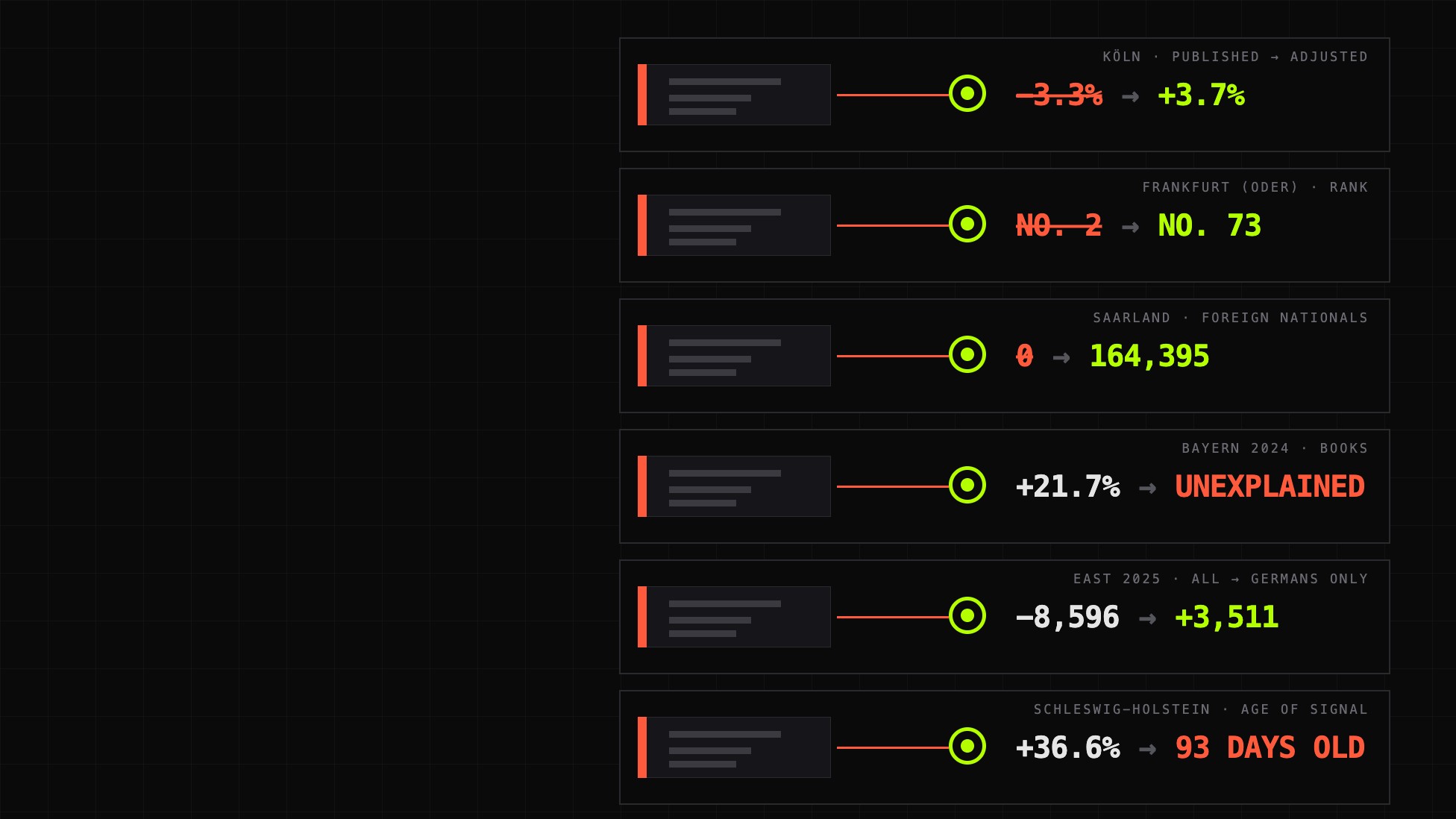
Why Germany's Official Numbers Keep Telling the Wrong Story
Every figure is correct, and the story is still wrong. We pulled real data from Destatis, the BKA and the EU into one system and went looking for the places where a true number says something false. We found six.

A Company Register That Watches Itself
Three cases on Austria's company register that add and drop companies on their own as filings arrive. In their first seven hours live, they took in 123 answers without a person touching them. Here is how we built them, and what they will not claim.