Point at the Words: Zero-Shot Extraction on 200 Real Contracts
What named entity recognition and zero-shot mean, how a small model finds facts it was never trained on, and what it found and missed in 200 real contracts.
A company is about to be sold. The buyer’s lawyers open the data room and find 200 contracts. They ask every one of them the same questions:
- Who signed it?
- When, and until when?
- How much notice does it take to end it?
- Which law governs it?
Each answer is written somewhere in the contract. “This Agreement shall be governed by the laws of the State of Delaware” sits on page fourteen. Finding it two hundred times is weeks of careful, dull reading.
You do not need a model that writes for this. You need one that points.
The 200 contracts are real: commercial agreements that US-listed companies filed with the Securities and Exchange Commission, published by The Atticus Project as the Contract Understanding Atticus Dataset (CUAD, CC BY 4.0). CUAD also publishes the answers lawyers wrote for each contract; we use them only to check the model. The sale and the buyer are our framing, and so are the two example sentences marked “illustration”. Every count was taken in the workspace on 28 October 2026. The pictures are stills from the film: the lime boxes, tags and notes on them are ours, not the product’s.
What named entity recognition is
Named entity recognition (NER) is one of the oldest jobs in language processing: find the names in a text, and say what kind each one is. A person, a company, a place, a date.

The classic way to build it is to train a model on thousands of sentences that people marked by hand. It learns those labels, and only those. If you want governing law or notice period, you mark a few thousand more sentences and train again. That is why NER was, for a long time, a fixed set of four or five labels.
What zero-shot means
Zero-shot turns that around. Zero means zero examples: the label is not learned in advance, you write it when you ask. A zero-shot extraction model reads your label as text, the same way it reads the document, compares it with every stretch of words, and keeps the stretches that match it closely enough.

So notice period stops being a training project. It is one line you type: “Notice needed to end the contract, e.g. ‘ninety (90) days’”.
GLiNER2 and GLiNER2.5
GLiNER2 is one of these models. It was published in 2025 with open weights (Apache 2.0) and has about 205 million parameters, small enough to run on an ordinary CPU, where chat models have billions.
It is an encoder: it reads the text and never writes a word. Everything it returns is either a piece of your document, with its position, or one of your own labels. It does several jobs in one pass: names, a classification and a structured record, all from one schema.

Why so many teams use it:
- Cost. Nothing is paid per page.
- Speed. It scores all your labels together, so fifty labels take barely longer than five (its paper measured 130 ms for 5 labels and 208 ms for 50, on a CPU).
- Privacy. Contracts, medical notes and personnel files never leave the building.
- Good enough. On the paper’s zero-shot test of finding names in five fields, it scored 59.0 F1, within a point of a large chat model’s 59.9.
It is used to redact personal data, pull fields out of documents, route requests and build knowledge graphs.
GLiNER2.5 came in August 2026. The older model tried every short stretch of words as a possible answer. The new one predicts where an answer starts and where it ends, so an answer can be any length and it reads about 4,000 words at a time. It comes in three sizes, from 74 to 287 million parameters; the largest reads many languages.

A rule worth keeping
What an extraction model does not do is think. It does not judge, and it does not calculate.

- Written in the text: a model that points (extraction). Parties, dates, notice periods, laws.
- A judgement with fixed options: a model that decides. Does this contract renew by itself? We wrote about these in One Look.
- Something to work out: a model that writes. The date a notice is due.
- A fixed shape: a pattern. An order or account number.
The data room
To see how far pointing goes, we built a data room that anyone can open.

The contracts come from CUAD, a public set made for exactly this test: 510 commercial agreements that US-listed companies filed with the SEC, with lawyers’ answers for 41 kinds of clause. A source reads 200 of them, the plain-text versions, straight from the public copy on Hugging Face. No account, no token, no copy in between.
The workspace has one source, one detector, three glossary schemes, three watches and two cases, all built with the ordinary product.

One detector, one pass. It names seven facts and asks one question. Each fact is a short label and a one-line description:
| Fact | Description the model reads |
|---|---|
party | A company or person that signs this agreement |
agreement_date | The date the agreement is made or entered into |
effective_date | The date the agreement takes effect |
term | How long the agreement runs or when it expires |
renewal | Wording that renews the agreement |
notice_period | Notice needed to terminate or to stop a renewal |
governing_law | State or country whose laws govern the agreement |
The question is what kind of agreement is this: licence, distribution, services, supply, marketing, partnership or IP transfer. The detector runs the newer GLiNER2.5, base size, inside the scan, on the scan’s own CPU.

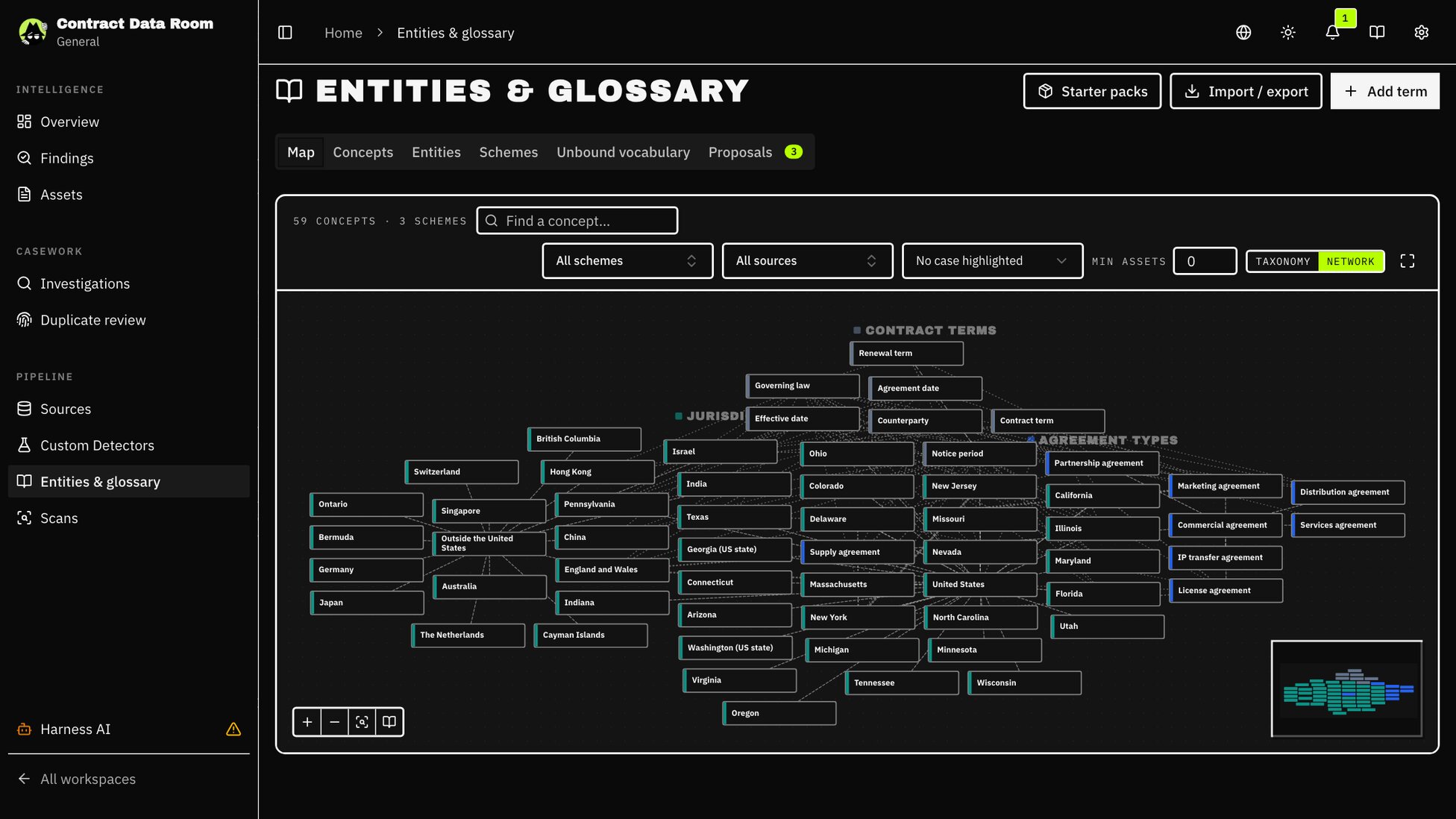
A glossary. Three schemes say what the outputs mean: a taxonomy of agreement types, the contract terms, and a list of jurisdictions with US states under United States and everything else under Outside the United States. The governing-law values are looked up in it, so “the laws of the State of New York”, “New York law” and “State of New York” all become New York.
One pass, one English clause
One pass over a contract hands back the words and where they sit. Here, a services agreement: “This Agreement is governed by the laws of England and Wales.” The glossary files England and Wales under Outside the United States. Nobody wrote a rule for England.

Everything the one pass extracted from one contract, label by label, with a confidence for each value:

Where the laws pile up
Across all two hundred, the laws pile up where you would expect: Delaware in 75 contracts, New York in 49, California in 34, then Nevada, Florida and Texas.
But 51 contracts name a law outside the United States: England and Wales in 16, China in 13, Israel in 7, then Hong Kong, Switzerland, Japan, the Netherlands, Germany and Singapore. 26 of them name no US law at all.

The agreement types spread almost evenly: services 39, supply 38, licences 36, marketing 17, partnerships 13, distribution 8 and IP transfers 2. The glossary’s map puts every one of these concepts, and every jurisdiction, on one page:

Who signs more than once. 26 companies are named as a party in two or more contracts: Cardlytics in four, A.M. Best and American International Group in three. Each became an entity, so every contract a company signed is one click away from it.

England, three times
Look closer at England, though.
One executive’s service agreement grants paid holiday “in addition to the usual public or bank holidays in England”. The model filed England as the governing law, 99% sure.

A second contract names England and Wales only as where a company is incorporated: “a company incorporated under the laws of England and Wales”. 99% again.

And the real governing-law clause, in the services agreement above, scored 65%, the lowest of six values in its row. First came FCA, a regulator, at 100%.

The model sees the words “the laws of England”. It cannot tell which clause they sit in. A high score means the words look like a governing law, not that the clause is one. Across the workspace, 88 of the 1,064 governing-law values, in 48 contracts, come straight after incorporated, organized or formed under the laws of: the law a company was set up under, not the law of the contract.
How close it came to the lawyers
CUAD comes with the answers lawyers wrote for every contract. A fact counts as found when one of the extracted values contains the lawyers’ answer, or the other way round; dates are compared as dates.
| Question | Found | Out of | Share |
|---|---|---|---|
| Who signed it (at least one party) | 190 | 193 | 98% |
| Which law governs it | 155 | 164 | 95% |
| When it was signed | 124 | 158 | 78% |
| What kind of agreement (where its title says) | 98 | 144 | 68% |
| Does it renew, and how | 4 | 65 | 6% |
Out of is the number of contracts for which the lawyers wrote an answer.

Renewal clauses are written in too many ways (“shall continue from year to year”, “unless either party gives notice”) for one short description. And asked whether a contract has a change-of-control clause, the model said yes to nearly all of them: it scored 0.82 to 0.99 on contracts the lawyers marked as having none. That is a judgement, not a pointer’s job.
The watch and the two cases
That is why the findings go to people, through watches and cases.
A watch follows a meaning, not a spelling. Governed by law outside the United States catches every contract the glossary files there, new ones included, whatever words the contract used.

Case one: contracts governed by law outside the United States. The watch feeds a case for deal counsel: 26 contracts that name only a foreign law, each needing a lawyer who knows that law before anyone relies on a reading of it. The working conclusion: brief local counsel per jurisdiction, starting with the laws that turn up more than once. A new contract under English or Chinese law joins the case by itself.

Case two: notice periods. 145 contracts state a notice period, from ten days to twenty-four months. The case tested one idea on those values: most contracts need two months’ notice or more. 100 of the 145 do, the middle value is 90 days, so the idea stands. The model hands over “twenty-four months”; counting back to a date in the calendar is the case’s work.

The cases are where the England catch matters. A contract filed under Outside the United States because of a holiday clause is one a lawyer opens, reads and drops from the case. The model highlights. The glossary says what it means. People decide.
What made the difference
One line of description per fact, with an example. The description is the model’s only instruction. “State or country whose laws govern the agreement, e.g. ‘the State of New York’” works. A longer description that also listed what the value is not made the results worse.
The right model for the language. The multilingual version was twice as slow on these English contracts and returned many more wrong governing-law values. Pick it for German or French text, not by default.
Ask the type of a document from its opening. Asked over the whole contract, the label that peaked in any one section won: a maintenance agreement with a long intellectual-property section became an IP transfer. On 23 contracts the agreement type matched the contract’s own title 7 times when judged over the whole text, and 15 times when judged from the opening.
Rules behind the model. A validation rule says what a value has to look like: a governing law has no digits and is not an Act; a term mentions years, months or days; a date contains a digit. On the first full scan these rules removed 485 of 1,485 governing-law values and half of the term values, and not one value that matched the lawyers’ answers. They do not catch England in a holiday clause: that looks exactly like a governing law.
Where it falls short
- It does not judge. Is there a clause that does X? is a question for a decision model or a fine-tuned one.
- It does not know the clause. It finds “the laws of England” wherever they are, in a governing-law clause, an incorporation clause or a holiday clause.
- It does not calculate. It returns “ninety (90) days prior written notice”, not the date the notice is due.
- It names roles as parties. Licensor, the Company and Provider come back along with the real company names.
- It costs CPU time. About 8 seconds per 1,000 words for each worker on the scan’s CPU in our setup. Two hundred contracts took 75 minutes. Nothing is paid per page, and nothing leaves the building.
When to use which
- The answer is written in the text and you want it word for word: an extraction model. Parties, dates, amounts, notice periods, product names, personal data without a fixed format.
- The answer is a judgement with fixed options: a decision model. Is this urgent, which team, does this contract have a change-of-control clause.
- The answer has to be worked out: a chat model. Count the days to the deadline, summarise the clause.
- The value has a fixed shape: a pattern. IBANs, order numbers, card numbers.
Open the Contract Data Room to read the findings, the glossary and the watches yourself, and the live case list for both cases. The detector is documented in the GLiNER2 Extraction guide.
More case files
Profit Is Reported, Cash Is Counted: Free Cash Flow of 385 UK Companies
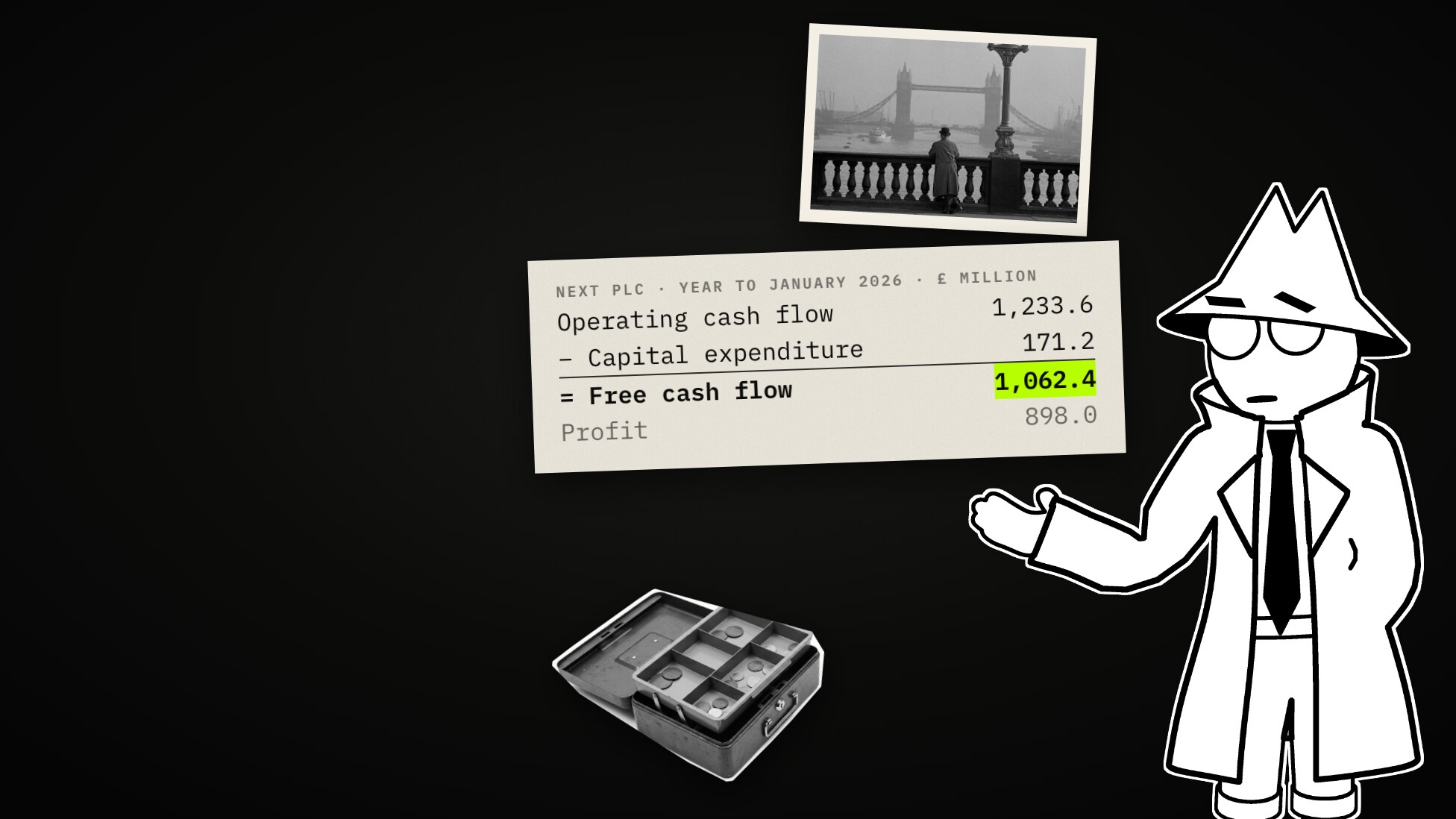
Free cash flow explained, then measured on every UK-listed company with a track record: 1,823 tagged annual reports from filings.xbrl.org, read year by year. Who turns profit into cash, who compounds, and what companies mean when they say free cash flow.
One Bad Friday at a Pump Factory: Four Rescue Ideas, and the One the Evidence Left Standing
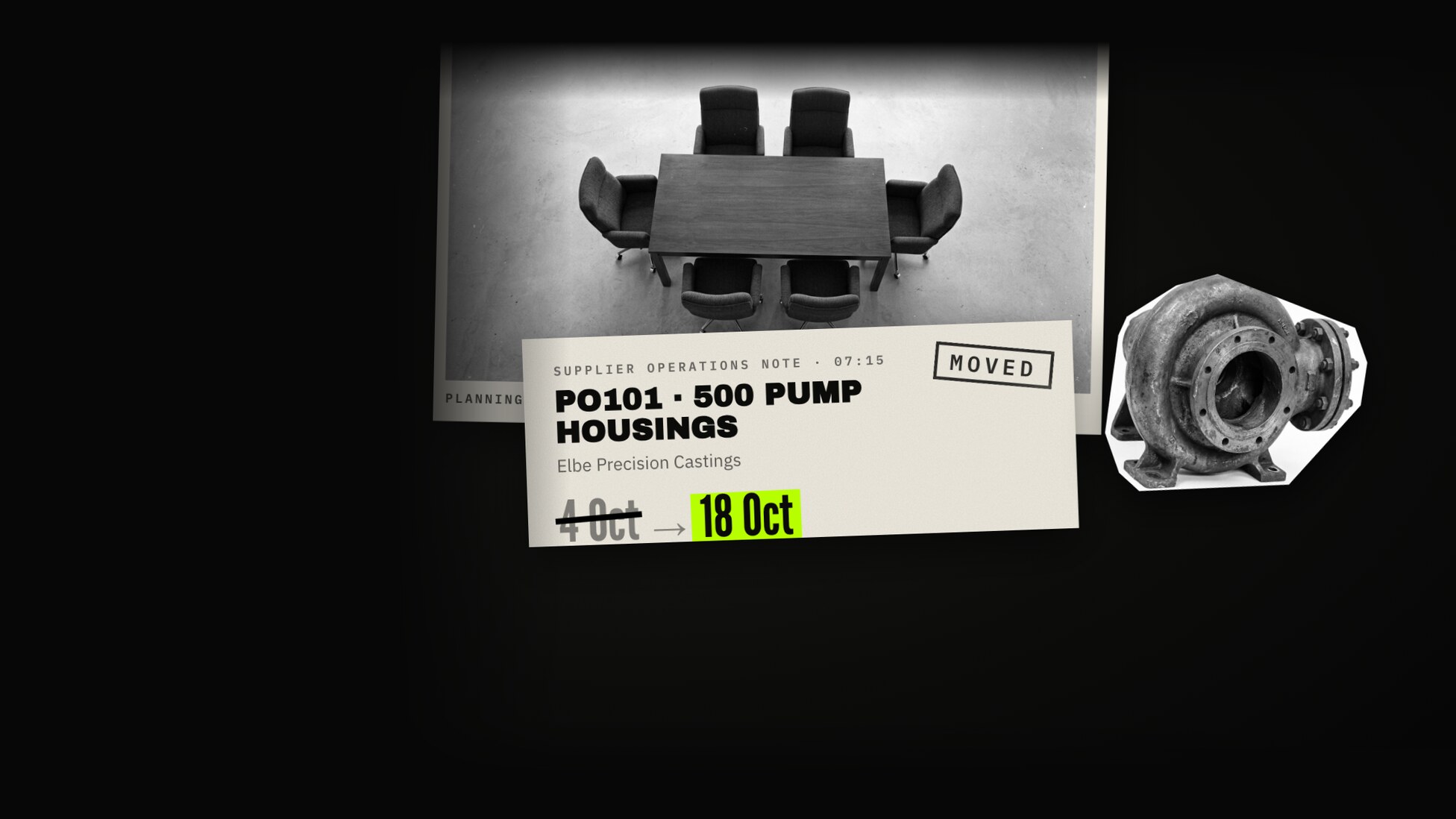
A delivery slips by two weeks and three orders hang on it. Four rescue ideas go on a case board as hypotheses, and one survives. A case file on Nova Manufacturing: an invented pump maker on a real workspace.